Wednesday, 3 September 2014

Where did everybody go?

September is here! Where did summer go? It seemed like we were just gearing up for the BC Women's Amateur Championship and now most of our staff is gone back to school. The last few months have certainly flown by, we had the Sunshine Open and are currently getting ready for the Club Championships this weekend. We completed an aeration of our greens in the last week of August, giving them a chance to breath after a hot dry summer. We were able to over come many challenges this year, while some are still an on going battle.

Blower turbine helping to contain duck weed

 One challenge we were faced with this year was Duck Weed in our ponds. Duck weed, (lemna minor) is an aquatic plant that can double itself overnight. Over the course of a few days, a small problem can turn into a large one. In past years we have sprayed them with an aquatic herbicide successfully. However, this year with the hot weather and a late herbicide application, the duck weed went out of control!


Manually removing duck weed


The only option left was to manually remove it from the ponds. This is a very labour intensive task. The first step was figuring out a way to contain the duck weed in one area of the pond to make removal more effective. We tried pool noodles, floatation systems, and finally had success with our blower/turbine. Blowing the duckweed to one side of the pond made it possible to remove with rakes and skimmers. Leaving on the shore to dry is an effective way to kill duckweed as it needs water to survive. We followed this with another aquatic herbicide application to kill off any remaining duck weed. Finally, it was gone!


Greens Aeration, 1/4 inch tines, 2.5" spacing
We successfully completed one of our 2 planned fall greens aeration. August 25th we did the front 9 and completed the back 9 on August 26th. With limited staff, doing 9 holes a day makes things more feasible. There are many different pieces of equipment involved in this process and it is certainty a lot of work. We don't aerate because it's fun, and we don't do it just to mess up your golf game, we do it because it's the best thing you can possible do for your greens. For more information please click this link: USGA: Why do we aerate when the greens are perfect?


Anthracnose on the 7th fairway (yellow and brown areas)


We have been battling an Anthracnose outbreak on our fairways and in our rough all through the end of summer and into September. Anthracnose is a foliar disease on annual bluegrass where symptoms include elongated stems, chlorotic (yellow) leaf spots with small, black, spore-bearing structures (acervuli) in the center. It is caipble of causing wide spread damage when conditions in late summer are favorable. To fight this disease there are a number of fungicides registered for control. We have chosen a more envirnmentally friendly approach, applying fertilizer with high nitrogen to bring the plants through until fall when they can over come the disease naturally.  
Antrhacnose symptoms up close


 As we transition into our fall season we will struggle to keep up with daily mowing and course services such as cleaning the washrooms and filling the sand and seed containers. Our staff has gone from a peak season of 7 full time staff and 5 part time staff to 4 full time staff and 2 part time staff. Many golf courses face this challenge in September as seasonal jobs are usually filled with university or high school students. Please have some patience and keep in mind that we are trying to get as much done as possible.


"Best Golf Course in Kamloops"


We have some exciting news at the Kamloops Golf and Country Club. In case you haven't heard, we have been voted "Kamloops Best Golf Course" by the Kamloops This Week Reader's Choice Awards. This is a very humbling award to receive. Our Turf Care team has worked tirelessly this season and it seems as though the rest of Kamloops has appreciated our efforts.


Thank you to everyone who voted for our course and to our staff who have worked so hard this season. We had a great year this year, and we will certainly try to keep things "best in kamloops" right into winter.


Thursday, 24 July 2014

2014 BC Women's Amateur Championship

Well folks, it has been a while since the last blog entry but I hope you can excuse us; we have been very busy having just recently hosted the 2014 BC Women's Amateur Championship! Preparation for this tournament began early this spring when the course opened. From planning our greens aeration's, topdressing, fertility programs and repairing the winter damaged areas, we aimed everything to have the course in the best shape as possible for this prestigious event.

From large scale repairs of fairway areas and bunker renovations, to small details including staining benches and string trimming, there is no one who could say we didn't have the course dialed in. Green's fertility was lean and mean, while the fairways were lush but firm. We received many compliments about the course from the competitors and members alike. The BCGA officials who last saw the course in late April could not believe the transformation that had taken place, going from a winter damaged course to a lush and vibrant one.

Our Turf Care Team worked extremely hard, so hard in fact I actually had to go out and tell them to slow down! They worked on their days off and did split shifts to make sure we got everything done on a daily basis without disturbing the competitors. Even Sam the dog was spotted mulching sticks at high speeds (pictured below). While it is a lot of work to bring the course to its full potential, it is both fun and rewarding to see everything so shined up and pristine. We had the greens running at over 11 feet on the stimp meter for the final round, by far the fastest and smoothest we have ever had them.

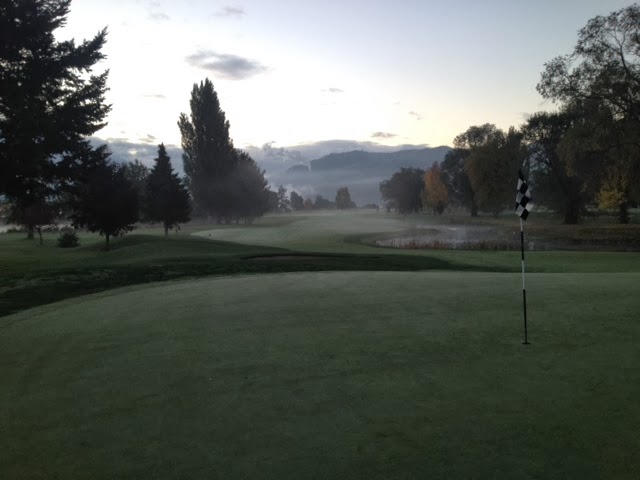
Morning shots, setting up for the Big Tournament

Some people may ask, "Why can't we have the course in this shape everyday?" Believe me, no one wants the course to be in perfect shape every day more than your Superintendent, it's our job! However, this just isn't possible to sustain on a daily basis. With financial limitations such as labour, and physical barriers such as trying to work during play, not to mention the detriment some of these practices can have on turf health, it's just not possible to do everything everyday. Things like rolling the greens, raking the bunkers and
The 1st Hole looking backwards
even cutting all the fairways are just not feasible when you have a limited crew of workers. We start early (5AM) to try and get as much work done as possible before golf starts (6:30AM), then work backwards around  the course to avoid seeing the same group of golfers twice. Many of these hi-intensity practices such as rolling and mowing at at low heights of cut are also very stressful to the turf itself. Continued practices like this can be done everyday, but as a result, we would have to manage our greens more intensely, costing more in fertilizer, fungicide and labour.

When hosting a major event it takes months of planning and intense labour to bring conditions to their peak. A tournament of this caliber showcases our course to the rest of the province and is a great source of marketing. A caddy of one of the competitor's told a member of the Club that this is the best conditioned course they have seen so far this year. Compliments like this can go a long way in boosting our Team's moral when they have worked so hard to prepair the course and is certainly something we strive to hear.

Final Hole of the Championship


The tournament went very well with no major issues all week... except for one irrigation head that stuck on the night before the final round on the 13th fairway! This caused some minor standing water, but we were out with squigee's moving the water away as much as we could. Our practice facilities have never seen so much use. These girls practice hard! To our surprise some began arriving daily at 5:30AM to begin practicing, then stayed after their round until dark. Dedication, to say the least. 

2014 BC Women's Amateur Championship - Turf Care Team
Once the event was over and we finished handwatering all the greens and replacing all of our course accessories, we were finally able to relax. After all is said and done it's all just another feather in our cap but will certainly be the benchmark that we will aim to bring the course conditions too again in the future. Thanks to all our Club's Staff and Volunteers who worked so hard for this event, it was a great success!


Thursday, 29 May 2014

A Nightmare of Elm Seeds

The 10th Tee
Looking over last years blog entries, it seems that May is one of the busiest months for our Turf Care Facility. Last year at this time there was a large gap between posts, and here I am at the end of May, apologizing again! It seems at this time of year it is a struggle to keep up with the growth rate of the grass and I often find myself becoming a part time operator/labourer on the course, limiting anytime I would usually get to be in the office. The grass in our climate enjoys rapid growth between 12C and 25C, which are exactly the high and low temperatures we have had for the past few weeks.

This year we are again challenged by a short staffed Turf Care Team and our ability to keep up with the mowing is an ongoing battle. Rough is especially tough to keep under control as we only have one rough mower. Once you fall behind, the wet long grass becomes even more difficult to cut. To help alleviate this problem some of us have been coming in periodically in the evenings to mow fairways and rough. We have also applied a growth regulator to the Fairways, Tees and Greens, helping  us get things back under control.

A Nightmare of Elm Seeds
Unfortunately someone about 30-40 years ago thought it would be a great idea to plant a bunch of  Elm trees all around the golf course. I curse this person. Elm trees are a live fast, die young tree; they spend all their energy trying to ensure their species survival by producing prolific amounts of seeds. Billions... trillions... gazillions!... of seeds that stick to everything when wet. Sticky when wet? Yes it's a thing, an elm seed thing. Every year for about 2-3 weeks in May we are inundated by an apocalypse of seeds, sometimes looking like a hellish snow storm of evil mess. They cover the ground, they stick to our mowers rollers, tires... even the operators! Spread onto cart paths, greens and fairways by golf carts and golf cleats, filling our bunkers up to your knees... okay, maybe just up the the ankles, but still, come on! As if we didn't have enough to deal with just trying to keep up with the growth of the grass, now it's A Nightmare of Elm Seeds. Yes, elm trees are really a pain in the arse!

Now that I've got that off my chest, I can give you an update on our recovery from winter damage.We are actually quite pleased with how most of the damage on the fairways has healed. Many areas that were dessicated by wind and cold damage are 90% - 100% recovered. Most of the areas that were damaged by crown hydration and/or ice damage/anoxia are well on their way to a full recovery, while a few stubborn areas are slower to fill in and may require additional seeding or sodding. We have used a number of techniques to repair these areas:

1) Aerate (shallow depth to create seed bed), topdress with sand and seed divot mix, fertilize
2) Aerate, drop seed, topdress with sand, fertilize
3) Slit overseed, roll, blow debris, fertilize

With each technique we saw success in areas, while in some the grass is still struggling to fill in. Using the green and white GUR stakes has also helped to keep most traffic out of these grow-in areas.

The 1st Fairway healing progress
 
The 4th green which suffered a small patch of crown hydration was slowly healing. As the area is mowed daily with the green and then walked on by golfers all day, healing was taking longer than desired. We decided to use hex plugs to fill in the remaining area of damage.

The 4th Green, before and after Hex Plugs


The 5th Fairway


The 4th green has a shade issue created by a large elm tree (you can see the trunk in the background). Shade can cause major issues for rapid ice formation in the late spring causing crown hydration (plant breaks dormancy, takes in water, then rapidly freezes). Since our course has 100's of trees, there are a number of other areas on the course that also have shade issues. We have been working with our arbourist to deal with some of these issues through crown lifting and crown thinning of the tree canopy's. As you can see in the photo to the left, the damaged area follows the shade pattern very closely.


As we move into June the grass will continue to heal, and as we get warmer temperatures, the growth rate will begin to slow and we will again be able to keep up with mowing. Our Turf Care Team is working towards bringing the course into peak conditions by July to host the 2014 BC Women's Amateur and Mid Amateur Championship. The event will see some of the best female golfers from around the western part of the continent. Please join us in welcoming this great event, as well as the Kamloops Golf and Country Club's 100th Anniversary Hickory Tournament July 19th weekend.


Monday, 14 April 2014

Centennial Year

Opening Day 2014
We opened the course for our Centennial season on March 21, 2014. It was a challenge trying to get things ready for Opening Day as things on the course were very soft. Rapid snow melt combined with frost beginning to come out of the ground made things difficult. This left us with only a few days before opening where we were actually able to get out onto the course without doing damage. To make matters worse, one of our three staff working came down with the flu and was not able to come in to work in the days leading up to opening. It was a challenge, but we managed to get things ready just in time.


4th Green frost heaving drainage trench
Frost heaving caused us some troubles on our greens. Some areas we saw the greens sub surface drainage settle faster than the surrounding soil. This caused trenches to form, making the herringbone drainage pattern visible from the surface. This heaving/sinking prevented us from cutting, rolling and basically doing anything besides blowing leaves from the green surface. Thankfully as the frost came out of the ground, the soil leveled out and we were finally able to get to work on the greens.


Our greens came out of winter very well with one exception on the 4th green. My suspicion is crown hydration. As the snow melted and pooled during the warmth of the day, the grass plants began to take in water. As the air cooled towards the end of the day, and the sun went behind the large elm tree behind the green, the water began to freeze while the plant was still taking it in; this causes its cells to rupture as the water expands to form ice. As you can see here, the ice formation is in a very similar pattern of the damage we see. This damage is not caused by the actual ice cover, as bentgrass can survive 120 days under ice, but from the plant taking in water as it freezes, a classic case of crown hydration.

Crown Hydration on the 4th Green

To remedy this area we have overseeded and fertilized. Our old Ryan Overseeder, which is probably older than me, worked perfectly to slit seed into the turf canopy and thatch layer. We also used this on all of our collars, and a few areas on greens that are high in poa concentration. If there was one thing helpful about this winter, it really knocked down the poa. Unlike what your parents probably taught you about fighting, when poa is down, that's the best time to kick it. Overseeding these areas with bentgrass will further help our fight against the invading poa, an ongoing battle.

Overseeding the 4th Green. Hey, who is that handsome fellow?
The photo on the left shows the tiny bentgrass seeds in the slits from the overseeder.

We will also be taking our little overseeder out onto some fairway areas where we have ice damage. Many of these areas are quite large, however, we can see little green shoots coming up in most areas, signs that these areas will come back with a little help from some fertilizer. A few smaller areas though, are basically white with death and will require overseeding as we move forward.

We are also excited to use a new product on our greens this year. ECO-TEA  is basically a high grade compost made from worm castings, kelp, humic/fulvic acids, and molasses. You can think of ECO-TEA as  beneficial microbes on steroids. It contains plant nutrients, amino acids, and other stress relieving compounds. This product will help in disease suppression of Take-all patch and reduce our fungicide needs. It boosts the soil microbe population, natural defenses for the plants, making them stronger and more efficient, also helping to reduce fertilizer needs, and in turn, reducing costs, saving us money. Soil chemisty and phisyology have always been utilized in turf management, but now soil biology is really becoming a useful and interesting tool.

Look out!, We've got a geyser! - Broken head on the Driving Range
Our irrigation system was fired up successfully, officially no breaks or leaks. I guess I know what I'm doing after all. A few irrigation heads were cracked or blown out at the nozzles, something that can happen due to the sheer pressure of compressed air during the fall blow out.


As we move into mid April now, the course is really starting to come to life. As things get greener both golfers and our staff are getting excited. The weather is finally starting to warm up and the course is bustling with activity. Our greens root mass is at least 3 times as deep as this point last year, a comfortable starting point for us to begin the golf season. Meanwhile, Sam the dog has found a new way to infiltrate the geese who have tried to make our course their home. They'll never see her coming! We are both very proud and excited to begin the Kamloops Golf and Country Club's Centennial year, it looks like it should be a great one.


Wednesday, 5 March 2014

Ice Ice Maybe

The winter of 2013/2014 may be one we remember for a long time in the golf course industry. The weather has blasted its way across the continent, dumping snow and freezing rain, pushing down arctic air and leaving us with terms like "Polar Vortex," something that sounds more like the finishing move of an Inuit wrestler, or a polar bear with an anger management problem.  
 
With all jokes aside, our friends out East have certainly had it the worst, but those of us out here in the West haven't exactly had it easy either. With record breaking cold snaps followed by near record warm spells, winter has been less than ideal for our little friend the grass plant.


Recorded at the Kamloops Airport


11th fairway Ice formation in Nov/2013.
With our 2010 conversion to bentgrass we should come out much better than we have in previous years of bad winters. Bentgrass goes dormant earlier and wakes up later than the native poa annua grass, making it more tolerant to the forces of winter. However, poa will always be creeping its way back in, no matter how hard we try to keep it out. Some of our low lying fairway areas where water accumulates have a higher concentration of poa. Bentgrass does not like to stay wet, causing plants in these areas to become weaker, allowing poa to move in quite easily. These are also the same areas we saw snow melt in November collect and form ice. So will the "Ice Ice Maybe" do some damage? Probably some, yes. We can expect to do some re-seeding in these low lying areas where ice accumlated. Much of the poa will not survive for such an extended period of time under ice and threat of thaw-freeze cycles.


All of the plugs we took on Jan 27th responded reasonably well when taken inside and watered.

Jan 27/2014

Feb 10/2014
These healthy plugs provide some comfort but also keep in mind we have had more thaw-freeze cycles and extreme cold through February. More sample plugs have been taken today and we will update you on their progress in the coming weeks.

The 4the Green looking towards tee. Feb 16th/2014
 Earlier in February most of the remaining snow cover had a layer of ice underneath. With temperatures expected to rise in mid February we decided that the best course of action for our greens would be to shovel herringbone surface drainage. This helps create pathways for water run off and helps to prevent pooling in low spots and re-freezing. By leaving the snow and ice layer intact, we would still have some protection from winter if temperatures dropped again. Much of the snow melted off but many areas were still left covered This was helpful as the the temperatures did drop quite substantially again towards the end of February, this can all be illustrated in the above graph.

As we prepare to open the course for a new season, our 100th season! we remain optimistic that the course has weathered well this winter. We expect to do some reseeding of fairway and rough areas, while greens and tees should come out in relatively good shape. We have ordered seed and fertilizer in preparation for our spring work. We are looking forward to another great year and are exited to bring back our core staff while recruiting a few new team members to bring us to our full potential.

We are currently aiming to open for Friday March 21, weather permitting. Please join us in welcoming the 100th year of the Kamloops Golf and Country Club.


Wednesday, 5 February 2014

What do you do in the Winter?

16th Hole, looking towards tee, Jan 29th
Winter is a strange time for people who work at golf courses in our climate, especially for those of us in the Turf Care profession. When meeting someone new, exchanging questions about careers is often an easy way to generate a conversation. The most frequent question we hear following anything to do with working on a golf course is, "What do you do in the Winter?" I find it interesting that this is usually the first thing most people think about. Why wouldn't people ask about the job itself? Why do they want to know what we do when the course is closed? Maybe it is because some of the things we do in the winter are actually pretty interesting too.


Quinton working on a Sidewinder Reel
During the the growing season, our Turf Care Centre is going full throttle and many things get put by the wayside until we have more time to work on them. Equipment is needed on a daily basis and any down time caused by a breakdown puts us behind the 8 ball so to speak. We do everything possible to fix the equipment properly, but must also keep in mind that it probably needs to go back out tomorrow. So often we leave the big jobs for the winter. Striping down engines and hydraulics, replacing electrical components, ripping out bearings, building and fabricating parts to make other jobs easier or more efficient. Quinton, our mechanic, takes great pride in grinding the reels, bed knives and rotary blades to a scientific precision in the winter, preparing them to get the best results next season.


We also go over last years budget numbers, looking at everything from labour, to chemicals, hydro, equipment parts etc.We look at where we can make improvements for next year and put together a comprehensive budget. Financial responsibility is obviously an important part of the job, especially in this day and age.


A great deal of this time is also spent planning and revising. Going over employee schedules to maximize outputs, putting together fertility plans and using what information we can collect to predict what inputs we will need in the spring. We monitor the course conditions underneath snow and ice. Taking samples of the turf to see how it responds indoors (simulated spring.) If we see growth we know we are okay; if they struggle, we know we are going to have our work cut out for us and can plan accordingly. Sometimes it may be necessary to remove snow and ice at certain times of the winter, a very labour intensive task, made all the more difficult as most Turf Care Teams are laid off for the winter.

Turf Samples taken Jan 27/2014

Turf Samples, Feb 5th
 
2 inch ice depth, low spot 11th Fairway, Jan 27th


Of course, as with any job, we take holidays. Summer holidays are nice, but we are usually too busy to leave for extended periods of time while the grass is growing. Winter offers us a chance to go somewhere warm, or just spend time with our family and friends, a part of life that we don't get to enjoy as much in the growing season. Some courses will also bank hours during the summer instead of taking overtime pay. We try and use these up in the winter, as we don't need to be at the course every day for 8 hours.

Another big part of winter is our continuing education. As professionals we seek to be on the cutting edge, or at least know where the cutting edge is (pun intended). We are always wanting to learn new and alternative ways of doing things. We attend Turf Conferences and seminars, which help us gain valuable knowledge and skills. Networking with other professionals at these events is also key. Learning about our colleagues practices and the different things they do at their course can help provide a different perspective. The industry is actually quite small, and most people are open to sharing their ideas with each other, something that is unique from many other businesses. With modern technology and the explosion of social media, networking has become even more valuable, a great tool that many Superintendents are embracing.

I sometimes hear grumblings from golfers about why the course employs people through the winter. Wouldn't the Club save money if they didn't have to pay someone in the winter? While this may be true in the very short term, after a few years I believe that this would actually cause the reverse effect. The topics discussed above can help prove the value of employing people through the winter. Not only would it be hard to attract someone who is a professional, someone who has invested in an education, someone who is qualified and will work their hardest for the Club; but to keep someone around year after year when they are forced to find other employment for the winter, or go on employment insurance, would be very difficult to say the least. In many ways the the winter season can be just as important for the golf course as the summer.

So the next time you meet someone who works on a golf course, you may have some insight as to what they do in the winter and why they do it. Sometimes it is quite interesting, sometimes... not so much. We have been know to take extended coffee breaks during the winter, but as you can see, we do a great deal while the course is closed, probably more than you thought.

Wednesday, 15 January 2014

Fore The Golfer

I recently came across this USGA YouTube channel called "Fore The Golfer." It is an excellent resource and something that every golfer should view. Watch and you might just learn something! These short videos do a great job of using a golfers perspective to explain some of the challenges we as Superintendents and Turf Care Staff face with maintaining a golf course.

The link will be available on the KGCC Turf Care Blog homepage menu. For now you can click the link below:

http://www.youtube.com/forethegolfer


Enjoy!

Tuesday, 7 January 2014

Winter's Wrath

So far this winter season, mother nature has been less than kind to us here at Kamloops Golf Club. Unlike last winter where we had snow cover from December till March with temperatures remaining steady throughout most of of the season. This year we had an early snowfall in November, which partially melted. This created ice in places where the snow melt pooled while leaving other areas of turf exposed to the elements of winter. This was followed by freezing rain which added to the formation of ice. I have recorded the major weather events that have potential to affect turf quality so far:

Nov 18 -- 3cm snow, wind 50km/hr, -5C
Nov 29 -- 1.5mm Freezing rain, +2C
Nov 30 -- 2mm Freezing rain, +2C     ICE FORMATION
Dec 1 -- 1.5mm Freezing rain, +5C  
Dec 2 -- wind 80km/hr, -7C, turf exposed
Dec 7 -- temperature dipping to -21C, turf exposed  DESICCATION POTENTIAL
Dec 11 -- 6cm snow
Dec 20 -- 9cm snow
Dec 27 -- 1mm freezing rain, +4C   ICE FORMATION                                        
Dec 28 -- +5C
Dec 29 -- 3cm snow
Jan 2 -- +4C    
Jan 4 -- +5C    FREEZE-THAW CYCLES
Jan 5 -- Temp down to -11C
Jan 10 -- (Forecast) +6C

With these records we can look at just how they may affect the quality of our turf when we come out in the spring.

There are four ways that the wrath of winter can cause damage to turf:

1) Disease
2) Ice/ Anoxia
3) Wind/cold Desiccation
4) Crown Hydration

Disease

When Superintendents talk about disease on turf, we are not talking about heart disease or lung cancer, for the most part we are talking about the formation of fungus that causes damage or death to the plant. In the case of winter there are two main fungi that are prevalent: Pink Snow Mold (Microdochium nivale) and Grey Snow Mold (Typhula incarnata). Pink snow mold thrives in moist cool envirnments, such as late fall and early spring. Snow melt can also contribute to the formation of pink snow mold. Grey snow mold thrives under the warmth and moisture of extended snow cover, both are capable of causing large areas of turf to die.

Snow Mold, 4th Tee surround, Spring 2013
To prevent the formation of these snow molds we apply a chemical fungicide in the late fall to protect through the winter. At Kamloops Golf Club we maintain environmental stewardship and only select products that have been proven to be safe for the environment. We are always seeking the newest technology to reduce our impact on the environment. As long as these products are applied successfully, they generally offer good protection against disease.

Ice/ Anoxia

The formation of ice over turf is also very destructive. As plants are living things, they require oxygen and release carbon dioxide to survive. Yes, you could say plants breathe too. When a solid layer of ice forms over the turf, the plant cannot take in oxygen and the carbon dioxide that is released remains trapped under the ice creating a toxic environment. These condition are known as Anoxia and can lead to turf death. However, the grass plant is smarter than it looks. In the fall the grass undergoes a process called "hardening off" as it goes dormant in preparation for winter. The plant stores carbohydrates to feed itself and to help to lower the freezing temperature of its cells. The accumulation of these carbohydrates helps the plant survive under ice for a certain amount of time. Poa annua is said to be able to survive for 30 days under ice cover, while bentgrass is 120 days.

Ice 11th Fwy, Dec 2013


 Ice chipping, 18th Fwy, Dec 2013
Preventing the formation of ice is very difficult, if not impossible. As snow accumulates and melts, it may freeze at the soil surface, creating ice. Not to mention the troubles freezing rain presents. We can attempt to chip the ice away, which often causes more damage than just leaving it alone. We can try and melt the ice with black sand, rubber crumbs etc. but then we leave the turf exposed until more snow cover occurs. Sometimes the best thing to do with ice, is just wait it out.

At Kamloops Golf Club we underwent a conversion from Poa to Bentgrass on our greens, tees and fairways during the renovation of 2010, but poa (the native grass) has been creeping back in since then. My philosophy is that if bentgrass is the grass we are trying to grow, and it can survive for 120 days (4 months) under ice, where poa can only survive for 1 month, let the ice kill off some poa, while the bentgrass stays alive. In doing this we can expect to do some re-seeding of areas in the spring, but will ultimately reduce the percentage of poa in our turfstand.

Wind/Cold Desiccation

Wind chill temperatures can create some of the most wide spread turf damage of all. At Kamloops Golf Club we are especially subject to this type of damage, as temperatures can reach below -20C and winds rolling off Kamloops Lake can gust over 80km/hr, creating a deathly wind chill. This is one of the primary reasons we decided to undergo a renovation and conversion to bentgrass in 2010.

Example of wind/cold damage
Much like living under ice, bentrgrass has a much better winter tolerance to wind and cold than poa annua. However, bentgrass is not invincible and can sustain damage in extreme weather, as can any living thing.

To protect and wind/cold desiccation we topdress the greens with a layer of sand to protect the crown/growing point from direct wind and cold. Snow cover also provides very good protection for the turf. The snow insulates and keeps temperatures at the surface closer to 0C and -1C, while at the same time, provides a cover from the wind. Unlike ice, snow is not a solid layer, so gas exchange of the turf is still able to take place.

Crown Hydration

The Grass Plant
As I mentioned, the crown of the grass plant is the point of growth, leaves and shoots grow up, and roots grow down. This makes it the most important part of the plant. If the crown dies, the plant dies. We also discussed how the turf prepares itself for winter and goes into dormancy. When temperatures during the winter and late spring rise above zero and cause snow to melt, the plant may take in some water, also known as hydration. If this happens over an extended period of time, the crown may begin to break dormancy and grow. The plant thinks spring has arrived and its time to wake up from winter. The crown now active, is much more susceptible to damage. If the temperature at the surface drops below zero again, the water in the crown may expand and cause the cell walls to rupture, causing death of the plant. Freeze - Thaw cycles are one of the most damaging forces to turf and can cause wide spread death to a turfstand.


Crown hydration damage example, spring re-seeding
Crown hydration is also very difficult to prevent. Some superintendents remove the snow in the late winter/early spring if they feel the temperatures will remain above or around 0C. The risk with this is if the temperature drops again and the turf is left exposed to desiccation as it is breaking dormancy.

As you can see, turfgrass faces some extreme challenges during the winter. As Superintendents we are often at the mercy of Mother Nature, and try as we might, sometimes we may end up doing more damage than if we let nature take its course.

Through the weather records above we can see that we have undergone many of processes in which turf may be damaged. Does that mean we may lose large amounts of turf this year? Not necessarily... We still have had a consistent snow cover since December 11, and although there are patches of ice remaining underneath, our conversion to bentgrass should offer some extended protection. We expect to do some re-seeding in the spring, but we do that every spring regardless. We can remain cautiously optimistic, with some luck, a nice warm spring will bring another great start to our season of golf at Kamloops Golf Club. We are looking forward to getting things going in just a few months.


Monday, 25 November 2013

Reflection

Winter is officially here. With the recent dump of snow and arctic like temperatures, Mother Nature wasted no time this year. But this also leaves me with some time to reflect on just how the season went. Reflection is an important tool for making improvements. Looking back on what worked and what didn't work is important in any profession, especially one where your product can potentially dictate your success or failure.

18th Hole, November 18th 2013

When I initially accepted the job of  Interim Superintendent here at Kamloops Golf Club I was a little skeptical of my abilities to perform the job. Having graduated from turf school only 2 years prior and having been an Assistant for only one year, I was pretty green to say the least. What I did know is that I learned first hand from a few outstanding mentors and had the internal drive to succeed on the job. Whatever I didn't know I would figure things out as I went, (or at least try my best to). Jumping in with both feet seemed like a good way to learn quickly.

After a great winter, the course came out in great shape and we were off to the races. As the season started up I found myself dealing with all sorts of new responsibilities. From water licenses, to ordering fertilizer, calculating application rates, interviewing and hiring staff, troubleshooting irrigation pumps in the middle of the night and trying to keep a life outside of work. The only thing  I could do was take it all in stride.

Managing people is something that I had done on a day to day basis as an Assistant, but now it was all day every day. I knew I would be a hands on Superintendent so leading by example was an easy way to motivate and see what was really going on out on the course. Part of the challenge of being a 26 year old boss is that some of your staff have been doing their job longer than you have been alive. Thankfully the staff on our Turf Care team were absolutely awesome and didn't miss a beat when I took the wheel. The long time staff were the least of my worries as they are able to get things done to a high level without much direction. The new staff require much more guidance, and after that it's sink or swim. We had a few great additions this year including our Intern from the Kwantlen Turf Management program, Sam Smith, who was a great asset for me personally. Taking over many spraying and irrigation duties as I was busy being a Superintendent.

When I started the year we set a few goals in terms of issues on the course. This included:
  • Spraying fungicides preventatively to avoid another Take-All Patch outbreak on the greens
  • Firming up the greens through heavier and more frequent sand topdressing and less frequent irrigation.
  • Completing a light solid tine spring aeration to prove we are able to aerate with out doing damage.
  • Growing a root-mass in the greens, capable of supporting the turf through the summer.
  • Cultivating and re-seeding weak and bare fairway areas that we have had trouble with since the renovation.
Roots in July 2013
Looking back on these goals we identified as the most important, I believe we achieved most of them. We didn't lose any turf on our greens, leading one to believe the fungicide applications worked, or at least the right conditions for the disease were not present this year. Our greens were definitely firmer, but still have room for improvement. Our solid tine aeration was a success and paved the way for us to complete 2 hollow tine aerations in the fall, which we think will put us that much further ahead for next year. Of course the goal all three of these practices were working towards was growing the root mass. In the previous year Take-All patch crippled our root system, making it impossible to dry out the greens and aerate without doing damage. Without a root system you have to baby the greens with light frequent irrigation, pushing them with dryness is just not an option.


The fairway areas turned out fairly well. Some areas where we cultivated and added amendments grew in nicely, while other still struggled. We found that modifying the surround irrigation heads through adding more or changing nozzles made a great deal of difference. Part of the trouble is you can never tell overnight if the changes have helped, a great deal of patience is required for these things, something that many golfers do not seem to understand. Sometimes it just took leveling an irrigation head or pruning tree branches that were blocking the water from reaching its target. Some of these things that just get overlooked or left out when you have such a small staff to work with. Another thing that helped was using the GUR stakes and traffic signs to try and keep people (including our mowers) off the seeded areas. While some of these areas are still a work in progress, we will continue to work on them as we move forward.

13th Hole, Sunshine open 2013
Sure, there is always room for improvement. I wish we were able to fix all the fairway areas and have the best greens in town. Although some people said that we did, its hard to believe them when it is your job to see all the things wrong out there. We could have added a few more irrigation heads than we did and probably should have renovated a few bunkers. But when funds are tight and staff is short, sometimes you just have to work with what you've got. I made a few rookie mistakes along the way but I guess that's part of gaining experience.

When all is said and done for this year, I feel we did a good job with what we had to work with. I am forever indebted to my senior staff, intern and and especially, mechanic, Quinton. Without Quinton there is no question my job would have been 100 times harder, and that would have been evident in the condition of the course this year. His knowledge and experience were very valuable tools for our turf care team this year, and I certainly owe him, big time.

14th Hole, Sunshine Open 2013
As we hunker down through the chill we are looking forward to warmer temperatures this week. All the fungicides were applied successfully and the course was put to bed just in time for Mother Nature to cool things out. An update on my last post about Sam the dog, she has since been reinstated at her position of goose control/ golf course greeter. It turns out there was a rule in the Club rules that says "no dogs on the the golf course" which has now been re-worded to state that the Superintendent may have his dog on the course for wildlife control purposes. Here is a video of Sam in action.


We are already gearing up for next year's big tournament... The 2014 BC Women's Amateur Championship, July 7 - 11. We are looking forward to the Challenge and getting the course prepared between now and then. Bring on the Ladies!...Haha, see you all in 2014.

Monday, 21 October 2013

This Place Has Gone To The Dogs

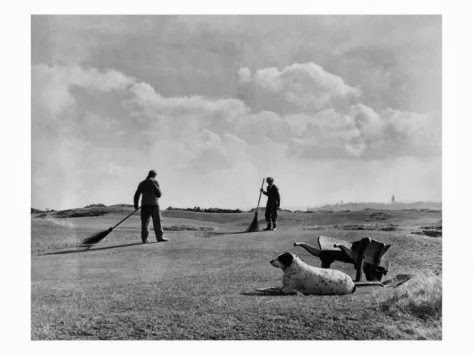
Taking a dog to work is a privilege that many Superintendents around the world have embraced. Since the game of golf as we know it was forged in St. Andrews, it has always been encouraged to keep dogs on the course.

Greenkeepers and their dog at the Old Course, St. Andrews. 1880's
Dogs provide a number of very beneficial additions to any golf course. Warding off wildlife including geese, deer, marmots and bears; providing protection for the course. A well trained friendly dog provides a happy wagging greeting to golfers who may need a break from the struggles that the game can often present us. Perhaps most importantly from a superintendents perspective is: helping to keep his (or her) sanity. Man's best friend can naturally provide uplifting spirits, through goofyness, respect and courage; I guess that's where the moniker comes from.


Meet Sam, she is a 3 year old Coon Hound/ Boxer mix who I adopted a year and a half ago. Sam is a happy go lucky dog who when at full flight is often confused for a greyhound. Her athleticism is an excellent tool to chase off geese and other wildlife that cause damage to the course or danger to the people on it. She is a golf course dog in training but has already figured out that she is not allowed on greens or in bunkers. Sam responds very well to voice commands, especially if treats are involved. She has learned not to approach golfers unless they approach her or call her over.

In the two weeks Sam has been working at the course the geese have vacated to the farmers field adjacent to the clubs property. She has made friends with many of the golfers who somehow knew to carry doggy treats in their bags. If Sam has one weakness, it is food. Being part Coon Hound does not help as she has a very keen sense of smell and can be drawn to someones bag, looking for a tasty snack


Unfortunately for Sam, it is often the displeased minority and not the pleased majority who speak out. One person recently wrote a complaint, saying a golf course is no place for a dog and that there are bylaws that prevent this. I am fairly certain that there are no such bylaws as they suggest, at least none that I could find on any City or Regional website.

For the past 10 years the former Superintendent and former Assistant have had their dogs on the course here at Kamloops G&CC. There was just recently a front page article published in the Kamloops This Week newspaper about a local colleague and his golf course dog. http://www.kamloopsthisweek.com. I also recently came across an article in the New York Times, yes the New York Times! talking about dogs on the golf course.http://www.nytimes.com Here is a blog by another colleague, entirely dedicated to his golf course dog. http://viewfromthecart.blogspot.ca/

I don't think I need to go any further in providing evidence that Superintendents bringing their well trained dog onto the golf course is common place. But for the time being I have been asked by the powers to be, to leave Sam at home unless the geese return to the course. If you feel that a golf course is a great place for a friendly well trained dog, please take the time to voice this opinion. Whether to the powers to be, or just a discussion amongst your group. I know Sam would certainly appreciate it.


In other news on the course, we are planning to keep the course open up to and including November 11, weather permitting. We have again been blessed with some nice weather, although creating frost delays for both golfers and workers in the mornings, warm sunny afternoons make the Kamloops Golf Club a great place to be. The Turf Care Team has been busy preparing the course for winter and we will only be busier now as our staff has been reduced to 3 people while the leaves are really starting to fall.


While picking up the leaves will carry on, we have just received our fall fungicide and will be spraying the Greens, Tees, and Fairways once the course is closed. Another major year end task is a heavy topdressing of the greens to protect the crowns, (or growing point of the turf) from winter dessication. We are also planning so cover some of our high and dry fairway areas with our old permeable greens tarps, helping to provide protection and give us a head start on keeping these areas healthy in the spring. We will be blowing out our irrigation system next Monday, October 28th. You can expect tee times to be delayed until at least 11am, and watch out for irrigation heads that may still be getting blown out while you play your round. Rescheduling your Monday round would be advisable!


We are excited to see that the Club has signed up over 65 new members and counting so far this year. Our team has worked extremely hard this year, and had some help with some nice weather. We feel humbled to see so many new people wanting to play our product and be a part of the Club. We strive towards continuing this trend, and hope to see more new faces in the coming months. So maybe I am wrong in saying "this place has gone to the dogs."