Wednesday, 5 March 2014

Ice Ice Maybe

The winter of 2013/2014 may be one we remember for a long time in the golf course industry. The weather has blasted its way across the continent, dumping snow and freezing rain, pushing down arctic air and leaving us with terms like "Polar Vortex," something that sounds more like the finishing move of an Inuit wrestler, or a polar bear with an anger management problem.  
 
With all jokes aside, our friends out East have certainly had it the worst, but those of us out here in the West haven't exactly had it easy either. With record breaking cold snaps followed by near record warm spells, winter has been less than ideal for our little friend the grass plant.


Recorded at the Kamloops Airport


11th fairway Ice formation in Nov/2013.
With our 2010 conversion to bentgrass we should come out much better than we have in previous years of bad winters. Bentgrass goes dormant earlier and wakes up later than the native poa annua grass, making it more tolerant to the forces of winter. However, poa will always be creeping its way back in, no matter how hard we try to keep it out. Some of our low lying fairway areas where water accumulates have a higher concentration of poa. Bentgrass does not like to stay wet, causing plants in these areas to become weaker, allowing poa to move in quite easily. These are also the same areas we saw snow melt in November collect and form ice. So will the "Ice Ice Maybe" do some damage? Probably some, yes. We can expect to do some re-seeding in these low lying areas where ice accumlated. Much of the poa will not survive for such an extended period of time under ice and threat of thaw-freeze cycles.


All of the plugs we took on Jan 27th responded reasonably well when taken inside and watered.

Jan 27/2014

Feb 10/2014
These healthy plugs provide some comfort but also keep in mind we have had more thaw-freeze cycles and extreme cold through February. More sample plugs have been taken today and we will update you on their progress in the coming weeks.

The 4the Green looking towards tee. Feb 16th/2014
 Earlier in February most of the remaining snow cover had a layer of ice underneath. With temperatures expected to rise in mid February we decided that the best course of action for our greens would be to shovel herringbone surface drainage. This helps create pathways for water run off and helps to prevent pooling in low spots and re-freezing. By leaving the snow and ice layer intact, we would still have some protection from winter if temperatures dropped again. Much of the snow melted off but many areas were still left covered This was helpful as the the temperatures did drop quite substantially again towards the end of February, this can all be illustrated in the above graph.

As we prepare to open the course for a new season, our 100th season! we remain optimistic that the course has weathered well this winter. We expect to do some reseeding of fairway and rough areas, while greens and tees should come out in relatively good shape. We have ordered seed and fertilizer in preparation for our spring work. We are looking forward to another great year and are exited to bring back our core staff while recruiting a few new team members to bring us to our full potential.

We are currently aiming to open for Friday March 21, weather permitting. Please join us in welcoming the 100th year of the Kamloops Golf and Country Club.


Wednesday, 5 February 2014

What do you do in the Winter?

16th Hole, looking towards tee, Jan 29th
Winter is a strange time for people who work at golf courses in our climate, especially for those of us in the Turf Care profession. When meeting someone new, exchanging questions about careers is often an easy way to generate a conversation. The most frequent question we hear following anything to do with working on a golf course is, "What do you do in the Winter?" I find it interesting that this is usually the first thing most people think about. Why wouldn't people ask about the job itself? Why do they want to know what we do when the course is closed? Maybe it is because some of the things we do in the winter are actually pretty interesting too.


Quinton working on a Sidewinder Reel
During the the growing season, our Turf Care Centre is going full throttle and many things get put by the wayside until we have more time to work on them. Equipment is needed on a daily basis and any down time caused by a breakdown puts us behind the 8 ball so to speak. We do everything possible to fix the equipment properly, but must also keep in mind that it probably needs to go back out tomorrow. So often we leave the big jobs for the winter. Striping down engines and hydraulics, replacing electrical components, ripping out bearings, building and fabricating parts to make other jobs easier or more efficient. Quinton, our mechanic, takes great pride in grinding the reels, bed knives and rotary blades to a scientific precision in the winter, preparing them to get the best results next season.


We also go over last years budget numbers, looking at everything from labour, to chemicals, hydro, equipment parts etc.We look at where we can make improvements for next year and put together a comprehensive budget. Financial responsibility is obviously an important part of the job, especially in this day and age.


A great deal of this time is also spent planning and revising. Going over employee schedules to maximize outputs, putting together fertility plans and using what information we can collect to predict what inputs we will need in the spring. We monitor the course conditions underneath snow and ice. Taking samples of the turf to see how it responds indoors (simulated spring.) If we see growth we know we are okay; if they struggle, we know we are going to have our work cut out for us and can plan accordingly. Sometimes it may be necessary to remove snow and ice at certain times of the winter, a very labour intensive task, made all the more difficult as most Turf Care Teams are laid off for the winter.

Turf Samples taken Jan 27/2014

Turf Samples, Feb 5th
 
2 inch ice depth, low spot 11th Fairway, Jan 27th


Of course, as with any job, we take holidays. Summer holidays are nice, but we are usually too busy to leave for extended periods of time while the grass is growing. Winter offers us a chance to go somewhere warm, or just spend time with our family and friends, a part of life that we don't get to enjoy as much in the growing season. Some courses will also bank hours during the summer instead of taking overtime pay. We try and use these up in the winter, as we don't need to be at the course every day for 8 hours.

Another big part of winter is our continuing education. As professionals we seek to be on the cutting edge, or at least know where the cutting edge is (pun intended). We are always wanting to learn new and alternative ways of doing things. We attend Turf Conferences and seminars, which help us gain valuable knowledge and skills. Networking with other professionals at these events is also key. Learning about our colleagues practices and the different things they do at their course can help provide a different perspective. The industry is actually quite small, and most people are open to sharing their ideas with each other, something that is unique from many other businesses. With modern technology and the explosion of social media, networking has become even more valuable, a great tool that many Superintendents are embracing.

I sometimes hear grumblings from golfers about why the course employs people through the winter. Wouldn't the Club save money if they didn't have to pay someone in the winter? While this may be true in the very short term, after a few years I believe that this would actually cause the reverse effect. The topics discussed above can help prove the value of employing people through the winter. Not only would it be hard to attract someone who is a professional, someone who has invested in an education, someone who is qualified and will work their hardest for the Club; but to keep someone around year after year when they are forced to find other employment for the winter, or go on employment insurance, would be very difficult to say the least. In many ways the the winter season can be just as important for the golf course as the summer.

So the next time you meet someone who works on a golf course, you may have some insight as to what they do in the winter and why they do it. Sometimes it is quite interesting, sometimes... not so much. We have been know to take extended coffee breaks during the winter, but as you can see, we do a great deal while the course is closed, probably more than you thought.

Wednesday, 15 January 2014

Fore The Golfer

I recently came across this USGA YouTube channel called "Fore The Golfer." It is an excellent resource and something that every golfer should view. Watch and you might just learn something! These short videos do a great job of using a golfers perspective to explain some of the challenges we as Superintendents and Turf Care Staff face with maintaining a golf course.

The link will be available on the KGCC Turf Care Blog homepage menu. For now you can click the link below:

http://www.youtube.com/forethegolfer


Enjoy!

Tuesday, 7 January 2014

Winter's Wrath

So far this winter season, mother nature has been less than kind to us here at Kamloops Golf Club. Unlike last winter where we had snow cover from December till March with temperatures remaining steady throughout most of of the season. This year we had an early snowfall in November, which partially melted. This created ice in places where the snow melt pooled while leaving other areas of turf exposed to the elements of winter. This was followed by freezing rain which added to the formation of ice. I have recorded the major weather events that have potential to affect turf quality so far:

Nov 18 -- 3cm snow, wind 50km/hr, -5C
Nov 29 -- 1.5mm Freezing rain, +2C
Nov 30 -- 2mm Freezing rain, +2C     ICE FORMATION
Dec 1 -- 1.5mm Freezing rain, +5C  
Dec 2 -- wind 80km/hr, -7C, turf exposed
Dec 7 -- temperature dipping to -21C, turf exposed  DESICCATION POTENTIAL
Dec 11 -- 6cm snow
Dec 20 -- 9cm snow
Dec 27 -- 1mm freezing rain, +4C   ICE FORMATION                                        
Dec 28 -- +5C
Dec 29 -- 3cm snow
Jan 2 -- +4C    
Jan 4 -- +5C    FREEZE-THAW CYCLES
Jan 5 -- Temp down to -11C
Jan 10 -- (Forecast) +6C

With these records we can look at just how they may affect the quality of our turf when we come out in the spring.

There are four ways that the wrath of winter can cause damage to turf:

1) Disease
2) Ice/ Anoxia
3) Wind/cold Desiccation
4) Crown Hydration

Disease

When Superintendents talk about disease on turf, we are not talking about heart disease or lung cancer, for the most part we are talking about the formation of fungus that causes damage or death to the plant. In the case of winter there are two main fungi that are prevalent: Pink Snow Mold (Microdochium nivale) and Grey Snow Mold (Typhula incarnata). Pink snow mold thrives in moist cool envirnments, such as late fall and early spring. Snow melt can also contribute to the formation of pink snow mold. Grey snow mold thrives under the warmth and moisture of extended snow cover, both are capable of causing large areas of turf to die.

Snow Mold, 4th Tee surround, Spring 2013
To prevent the formation of these snow molds we apply a chemical fungicide in the late fall to protect through the winter. At Kamloops Golf Club we maintain environmental stewardship and only select products that have been proven to be safe for the environment. We are always seeking the newest technology to reduce our impact on the environment. As long as these products are applied successfully, they generally offer good protection against disease.

Ice/ Anoxia

The formation of ice over turf is also very destructive. As plants are living things, they require oxygen and release carbon dioxide to survive. Yes, you could say plants breathe too. When a solid layer of ice forms over the turf, the plant cannot take in oxygen and the carbon dioxide that is released remains trapped under the ice creating a toxic environment. These condition are known as Anoxia and can lead to turf death. However, the grass plant is smarter than it looks. In the fall the grass undergoes a process called "hardening off" as it goes dormant in preparation for winter. The plant stores carbohydrates to feed itself and to help to lower the freezing temperature of its cells. The accumulation of these carbohydrates helps the plant survive under ice for a certain amount of time. Poa annua is said to be able to survive for 30 days under ice cover, while bentgrass is 120 days.

Ice 11th Fwy, Dec 2013


 Ice chipping, 18th Fwy, Dec 2013
Preventing the formation of ice is very difficult, if not impossible. As snow accumulates and melts, it may freeze at the soil surface, creating ice. Not to mention the troubles freezing rain presents. We can attempt to chip the ice away, which often causes more damage than just leaving it alone. We can try and melt the ice with black sand, rubber crumbs etc. but then we leave the turf exposed until more snow cover occurs. Sometimes the best thing to do with ice, is just wait it out.

At Kamloops Golf Club we underwent a conversion from Poa to Bentgrass on our greens, tees and fairways during the renovation of 2010, but poa (the native grass) has been creeping back in since then. My philosophy is that if bentgrass is the grass we are trying to grow, and it can survive for 120 days (4 months) under ice, where poa can only survive for 1 month, let the ice kill off some poa, while the bentgrass stays alive. In doing this we can expect to do some re-seeding of areas in the spring, but will ultimately reduce the percentage of poa in our turfstand.

Wind/Cold Desiccation

Wind chill temperatures can create some of the most wide spread turf damage of all. At Kamloops Golf Club we are especially subject to this type of damage, as temperatures can reach below -20C and winds rolling off Kamloops Lake can gust over 80km/hr, creating a deathly wind chill. This is one of the primary reasons we decided to undergo a renovation and conversion to bentgrass in 2010.

Example of wind/cold damage
Much like living under ice, bentrgrass has a much better winter tolerance to wind and cold than poa annua. However, bentgrass is not invincible and can sustain damage in extreme weather, as can any living thing.

To protect and wind/cold desiccation we topdress the greens with a layer of sand to protect the crown/growing point from direct wind and cold. Snow cover also provides very good protection for the turf. The snow insulates and keeps temperatures at the surface closer to 0C and -1C, while at the same time, provides a cover from the wind. Unlike ice, snow is not a solid layer, so gas exchange of the turf is still able to take place.

Crown Hydration

The Grass Plant
As I mentioned, the crown of the grass plant is the point of growth, leaves and shoots grow up, and roots grow down. This makes it the most important part of the plant. If the crown dies, the plant dies. We also discussed how the turf prepares itself for winter and goes into dormancy. When temperatures during the winter and late spring rise above zero and cause snow to melt, the plant may take in some water, also known as hydration. If this happens over an extended period of time, the crown may begin to break dormancy and grow. The plant thinks spring has arrived and its time to wake up from winter. The crown now active, is much more susceptible to damage. If the temperature at the surface drops below zero again, the water in the crown may expand and cause the cell walls to rupture, causing death of the plant. Freeze - Thaw cycles are one of the most damaging forces to turf and can cause wide spread death to a turfstand.


Crown hydration damage example, spring re-seeding
Crown hydration is also very difficult to prevent. Some superintendents remove the snow in the late winter/early spring if they feel the temperatures will remain above or around 0C. The risk with this is if the temperature drops again and the turf is left exposed to desiccation as it is breaking dormancy.

As you can see, turfgrass faces some extreme challenges during the winter. As Superintendents we are often at the mercy of Mother Nature, and try as we might, sometimes we may end up doing more damage than if we let nature take its course.

Through the weather records above we can see that we have undergone many of processes in which turf may be damaged. Does that mean we may lose large amounts of turf this year? Not necessarily... We still have had a consistent snow cover since December 11, and although there are patches of ice remaining underneath, our conversion to bentgrass should offer some extended protection. We expect to do some re-seeding in the spring, but we do that every spring regardless. We can remain cautiously optimistic, with some luck, a nice warm spring will bring another great start to our season of golf at Kamloops Golf Club. We are looking forward to getting things going in just a few months.


Monday, 25 November 2013

Reflection

Winter is officially here. With the recent dump of snow and arctic like temperatures, Mother Nature wasted no time this year. But this also leaves me with some time to reflect on just how the season went. Reflection is an important tool for making improvements. Looking back on what worked and what didn't work is important in any profession, especially one where your product can potentially dictate your success or failure.

18th Hole, November 18th 2013

When I initially accepted the job of  Interim Superintendent here at Kamloops Golf Club I was a little skeptical of my abilities to perform the job. Having graduated from turf school only 2 years prior and having been an Assistant for only one year, I was pretty green to say the least. What I did know is that I learned first hand from a few outstanding mentors and had the internal drive to succeed on the job. Whatever I didn't know I would figure things out as I went, (or at least try my best to). Jumping in with both feet seemed like a good way to learn quickly.

After a great winter, the course came out in great shape and we were off to the races. As the season started up I found myself dealing with all sorts of new responsibilities. From water licenses, to ordering fertilizer, calculating application rates, interviewing and hiring staff, troubleshooting irrigation pumps in the middle of the night and trying to keep a life outside of work. The only thing  I could do was take it all in stride.

Managing people is something that I had done on a day to day basis as an Assistant, but now it was all day every day. I knew I would be a hands on Superintendent so leading by example was an easy way to motivate and see what was really going on out on the course. Part of the challenge of being a 26 year old boss is that some of your staff have been doing their job longer than you have been alive. Thankfully the staff on our Turf Care team were absolutely awesome and didn't miss a beat when I took the wheel. The long time staff were the least of my worries as they are able to get things done to a high level without much direction. The new staff require much more guidance, and after that it's sink or swim. We had a few great additions this year including our Intern from the Kwantlen Turf Management program, Sam Smith, who was a great asset for me personally. Taking over many spraying and irrigation duties as I was busy being a Superintendent.

When I started the year we set a few goals in terms of issues on the course. This included:
  • Spraying fungicides preventatively to avoid another Take-All Patch outbreak on the greens
  • Firming up the greens through heavier and more frequent sand topdressing and less frequent irrigation.
  • Completing a light solid tine spring aeration to prove we are able to aerate with out doing damage.
  • Growing a root-mass in the greens, capable of supporting the turf through the summer.
  • Cultivating and re-seeding weak and bare fairway areas that we have had trouble with since the renovation.
Roots in July 2013
Looking back on these goals we identified as the most important, I believe we achieved most of them. We didn't lose any turf on our greens, leading one to believe the fungicide applications worked, or at least the right conditions for the disease were not present this year. Our greens were definitely firmer, but still have room for improvement. Our solid tine aeration was a success and paved the way for us to complete 2 hollow tine aerations in the fall, which we think will put us that much further ahead for next year. Of course the goal all three of these practices were working towards was growing the root mass. In the previous year Take-All patch crippled our root system, making it impossible to dry out the greens and aerate without doing damage. Without a root system you have to baby the greens with light frequent irrigation, pushing them with dryness is just not an option.


The fairway areas turned out fairly well. Some areas where we cultivated and added amendments grew in nicely, while other still struggled. We found that modifying the surround irrigation heads through adding more or changing nozzles made a great deal of difference. Part of the trouble is you can never tell overnight if the changes have helped, a great deal of patience is required for these things, something that many golfers do not seem to understand. Sometimes it just took leveling an irrigation head or pruning tree branches that were blocking the water from reaching its target. Some of these things that just get overlooked or left out when you have such a small staff to work with. Another thing that helped was using the GUR stakes and traffic signs to try and keep people (including our mowers) off the seeded areas. While some of these areas are still a work in progress, we will continue to work on them as we move forward.

13th Hole, Sunshine open 2013
Sure, there is always room for improvement. I wish we were able to fix all the fairway areas and have the best greens in town. Although some people said that we did, its hard to believe them when it is your job to see all the things wrong out there. We could have added a few more irrigation heads than we did and probably should have renovated a few bunkers. But when funds are tight and staff is short, sometimes you just have to work with what you've got. I made a few rookie mistakes along the way but I guess that's part of gaining experience.

When all is said and done for this year, I feel we did a good job with what we had to work with. I am forever indebted to my senior staff, intern and and especially, mechanic, Quinton. Without Quinton there is no question my job would have been 100 times harder, and that would have been evident in the condition of the course this year. His knowledge and experience were very valuable tools for our turf care team this year, and I certainly owe him, big time.

14th Hole, Sunshine Open 2013
As we hunker down through the chill we are looking forward to warmer temperatures this week. All the fungicides were applied successfully and the course was put to bed just in time for Mother Nature to cool things out. An update on my last post about Sam the dog, she has since been reinstated at her position of goose control/ golf course greeter. It turns out there was a rule in the Club rules that says "no dogs on the the golf course" which has now been re-worded to state that the Superintendent may have his dog on the course for wildlife control purposes. Here is a video of Sam in action.


We are already gearing up for next year's big tournament... The 2014 BC Women's Amateur Championship, July 7 - 11. We are looking forward to the Challenge and getting the course prepared between now and then. Bring on the Ladies!...Haha, see you all in 2014.

Monday, 21 October 2013

This Place Has Gone To The Dogs

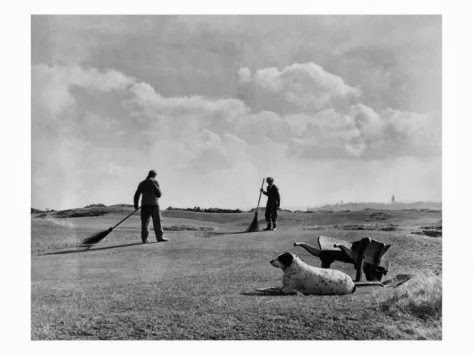
Taking a dog to work is a privilege that many Superintendents around the world have embraced. Since the game of golf as we know it was forged in St. Andrews, it has always been encouraged to keep dogs on the course.

Greenkeepers and their dog at the Old Course, St. Andrews. 1880's
Dogs provide a number of very beneficial additions to any golf course. Warding off wildlife including geese, deer, marmots and bears; providing protection for the course. A well trained friendly dog provides a happy wagging greeting to golfers who may need a break from the struggles that the game can often present us. Perhaps most importantly from a superintendents perspective is: helping to keep his (or her) sanity. Man's best friend can naturally provide uplifting spirits, through goofyness, respect and courage; I guess that's where the moniker comes from.


Meet Sam, she is a 3 year old Coon Hound/ Boxer mix who I adopted a year and a half ago. Sam is a happy go lucky dog who when at full flight is often confused for a greyhound. Her athleticism is an excellent tool to chase off geese and other wildlife that cause damage to the course or danger to the people on it. She is a golf course dog in training but has already figured out that she is not allowed on greens or in bunkers. Sam responds very well to voice commands, especially if treats are involved. She has learned not to approach golfers unless they approach her or call her over.

In the two weeks Sam has been working at the course the geese have vacated to the farmers field adjacent to the clubs property. She has made friends with many of the golfers who somehow knew to carry doggy treats in their bags. If Sam has one weakness, it is food. Being part Coon Hound does not help as she has a very keen sense of smell and can be drawn to someones bag, looking for a tasty snack


Unfortunately for Sam, it is often the displeased minority and not the pleased majority who speak out. One person recently wrote a complaint, saying a golf course is no place for a dog and that there are bylaws that prevent this. I am fairly certain that there are no such bylaws as they suggest, at least none that I could find on any City or Regional website.

For the past 10 years the former Superintendent and former Assistant have had their dogs on the course here at Kamloops G&CC. There was just recently a front page article published in the Kamloops This Week newspaper about a local colleague and his golf course dog. http://www.kamloopsthisweek.com. I also recently came across an article in the New York Times, yes the New York Times! talking about dogs on the golf course.http://www.nytimes.com Here is a blog by another colleague, entirely dedicated to his golf course dog. http://viewfromthecart.blogspot.ca/

I don't think I need to go any further in providing evidence that Superintendents bringing their well trained dog onto the golf course is common place. But for the time being I have been asked by the powers to be, to leave Sam at home unless the geese return to the course. If you feel that a golf course is a great place for a friendly well trained dog, please take the time to voice this opinion. Whether to the powers to be, or just a discussion amongst your group. I know Sam would certainly appreciate it.


In other news on the course, we are planning to keep the course open up to and including November 11, weather permitting. We have again been blessed with some nice weather, although creating frost delays for both golfers and workers in the mornings, warm sunny afternoons make the Kamloops Golf Club a great place to be. The Turf Care Team has been busy preparing the course for winter and we will only be busier now as our staff has been reduced to 3 people while the leaves are really starting to fall.


While picking up the leaves will carry on, we have just received our fall fungicide and will be spraying the Greens, Tees, and Fairways once the course is closed. Another major year end task is a heavy topdressing of the greens to protect the crowns, (or growing point of the turf) from winter dessication. We are also planning so cover some of our high and dry fairway areas with our old permeable greens tarps, helping to provide protection and give us a head start on keeping these areas healthy in the spring. We will be blowing out our irrigation system next Monday, October 28th. You can expect tee times to be delayed until at least 11am, and watch out for irrigation heads that may still be getting blown out while you play your round. Rescheduling your Monday round would be advisable!


We are excited to see that the Club has signed up over 65 new members and counting so far this year. Our team has worked extremely hard this year, and had some help with some nice weather. We feel humbled to see so many new people wanting to play our product and be a part of the Club. We strive towards continuing this trend, and hope to see more new faces in the coming months. So maybe I am wrong in saying "this place has gone to the dogs."

Monday, 16 September 2013

Greens Aeration

As we approach the end of the golf season the Turf Care Team has successfully undertaken another Greens Aeration. Using 1/4 inch side eject, carbide tipped aeration tines on a 2.5 inch spacing we removed cores and filled them with topdressing sand. The procedure is labour intensive and our crew puts a great deal of hard work into disrupting golf as little as possible.

Core Aeration, 4th Green

Brushing Topdressing Sand into Aeration holes, Proshop Putter

Brushing and Rolling remaining sand, 4th Green


Why do you have to punch the greens?

Aeration is perhaps the most important cultural practice to perform on a turf putting surface for a number of reasons:

1) Water infiltration
2) Nutrient absorption
3) Gas exchange
4) Improving plant health
5) Improving the putting surface

Aeration on the Kamloops Golf and Country Club Greens is even more important now than it has ever been. In 2010/2011 the Greens were completely replaced during the Renovation. In order to have the course open in time for the summer a choice was made to use sod, not seed to turf the putting surface. The sod company purposely grows a thatch/orgainic layer in the turf so they are able to remove and transport the turf to its new site. After the grassing of the greens is complete aeration is important to remove the thatch layer as much as possible and help blend the turf onto its new soil, the turf soil interface. Aerating shortly after the Grand Opening was not an option, the Club needed the greens to be open, so aeration was delayed

In the fall of 2011 the greens were able to be successfully aerated and the thatch layer was reduced.

In 2012 the greens sustained an outbreak of the disease known as Take All Patch which devastated many areas of the greens, aerating was again out of the question. The green's rootmass was destroyed by the disease and too fragile to sustain the mechanical stress caused by aeration. Under these circumstances the thatch layer has been able to grow and grow, making it more important than ever to aerate.

Now in 2013 we have disease under control and have been able to establish a rootmass. We are able to aerate, and aerate we shall! We preformed a light solid tine aeration in the spring, a moderate core aeration at the begging of September and we are preparing for another moderate aeration for the end of September. Aerating has already helped improve our greens, and continuing with this cultural practice we will continue to attain the following:

Physically removing portions of the thatch layer. 

This layer of organic material produced by the turfs regeneration holds water at the surface making it hard for water and nutrients to penetrate down into the root zone, the plant's primary source for nutrient and water absorption. This thatch layer causes the putting surface to remain wet and soft after watering as the water is being held at the surface instead of the rootzone beneath.

Replacing the thatch layer with topdressing sand.

By replacing the thatch layer with sand we can provide channels where water and nutrients are able to easily travel through and provide the rootzone with accessible oxygen, while releasing carbon dioxide. (AKA gas exchange). The sand channels with keep the surface dry and firm as the water is able to penetrate the surface and reach the rootzone.

Aeration: removing thatch, replacing with sand. (displacement.) Proshop Putter


It has been said that this year the Greens at Kamloops are amongst the best in town, if we want them to continue to improve and become the best, then we must continue to aerate and topdress, even if more golf is disrupted. As mentioned before, we plan and work hard to minimize the disruption of golf, but it is inevitable that people will have to putt on greens with aeration holes.

During a wet period at the end of August, a number of disease patches were evident of the fairways and parts of the greens. Although disease/ fungus is always present in the soil, it requires wet and warm conditions to reproduce to a level in which it can cause damage. A small amount of fungicide was purchased to control Yellow Tuft and Pythium Blight, the two diseases suspected of being active. To save money, only the areas with visible disease activity were targeted with fungicide, instead of  doing a blanket spray of the entire fairway, saving the club approximately $5000. All of the greens were sprayed, the more expensive (yet more effective) fungicide was used on the greens with the most disease activity, while others were sprayed with a less expensive but still relatively effective alternative, again saving money.

Disease symptoms, recovering, post fungicide


As we transition into the fall season the Turf Care team is currently aerating fairway and rough areas, and has plans for aeration of tees and greens again in the coming weeks. As a team we always look forward to performing tasks to make improvements for next year.


Tuesday, 27 August 2013

The 2013 Sunshine Open

The 2013 Sunshine Open kicked off on a windy Saturday August 17th with the course looking beautiful and the playing conditions fast and firm. Our Turf Care Team worked tirelessly to prepare the course for the big event, and was rewarded by seeing the fruits of their labour.

The 12th Green, August 17th
The tournament went smoothly, nothing out of the ordinary, oh except for when that horse ran across the 17th green right in the middle of play! Fortunately it stayed away from the pin placement, allowing us to plug out most of the worst damage between groups.

17th Green/Corral
Hoof damage


The 17th green has really taken a beating in the last few weeks, we also had a hydraulic hose break, leaving a stripe of oil across the green. It was small enough that we were able to cut it out and push the turf back together, similar to how you would fix a ball mark. After the horse trampled the green in nearly the same spot, I responded with, "well at least people wont notice the oil leak anymore."

17th Green Hydraulic Leak


New Toro Triflex
We had many compliments on the course during the tournament, the greens were stimping at about 11 ft and rolling true. I must admit, while plugging the hoof marks on the 17th, I enjoyed watching players blow the ball by the hole after barely moving their putter. We were able to utilize our new Toro Triflex greens mower before rolling the greens and were very pleased with the results.


The weeks leading into the Sunshine Open are when our Turf Care Team really put the pedal to the floor as we ramp things up for the Tournament. This year with our short staff we really pushed hard to prepare the course. A big thanks goes out to the Turf Care Team who made this all possible.

2013 Sunshine Open Turf Care Team left to right: Back Row: Quinton Harasemchuk, Cam Carnegie, Greg Hill, Travis Olson, Mike Lundin, Sam Smith. Front Row: Bianca Mirabelli, Sarah Schwauren, Kenyan Nagy, Kayley Pilon. Missing from photo (playing in Sunshine Open) Dino Porco, Audi Ferretti
Irrigation Addition between the 13th and 14th fwy
As we start winding down the golf season we will be caring out many course improvements including: adding additional irrigation heads in selected areas, aerating /topdressing Greens, Tees, and Fairway areas. Verticutting fairways and fertilizing as needed. We will still be spraying fungicides for TakeAll Patch and continuing on our cultural practices program.

Lets hope for some more good weather this fall to help us continue improving the course. It looks like the leaves on the trees are already starting to turn.


Saturday, 27 July 2013

The Dog Days Have Begun

It has been quite a while since the last blog post, which reflects just how busy we have been so far this year. I do enjoy writing these posts, but as the season is ramping up it is hard to find time to sit down and go through the writing process when there are more important things to take care of on the course. In this entry I would like to talk about some of the issues we have had over the past few months.

Feeling the Heat

With a recent heat wave sweeping through the southern part of our Province, the course is showing the weak spots of irrigation coverage. The system has literally been running beyond capacity in the last few weeks, we have had to turn on our backup pump system to try and keep up with the course's demand for water. You may notice some dry areas and some wet areas. The dry areas are a result of poor irrigation coverage, while the wet areas are a symptom of trying to keep the dry areas near them alive. Keep in mind that although we have a new irrigation system there were many areas that were cut back during the Renovation, and that even with our old irrigation system we were still adding sprinkler heads and making adjustments for 30 years after it was installed and right up to the new one was started. Our new system is much better than the old one but it will take time and money to continue improving it.

Another problem we face with our irrigation system is our dependance on the City Effluent/Waste Water. The effluent is great because we did not have to put in a new pump house with pumps during the Renovation, saving the Club a great deal of money, but now the new system is designed around using the Effluent as our main source. The effluent can often become "dirty" with debris and sediment from the reservoir, which makes its way into our system, clogging up our sprinkler heads. Clogged sprinkler heads give us a 'head'-ache. Haha, bad joke.


The debris also gets caught in the sprinkler valves, causing them to stay on until we arrive in the morning and shut them off manually.We have been in conversation with the city about installing a filter on the effluent line and will see where that goes.


We have also had a problem with some of the sprinkler valves leaking and creating small puddles around the sprinkler head. Yes, we know they are there and we are planning to fix them. One of these valves costs $70 which can get quite costly, we are looking at getting some on warrenty.

The 5th tee was accidentally turned off when a sprinkler head on the 5th fairway (puddle shown above) was stuck on and was manually turned off, then fixed. When the fifth fairway was turned back on, the person fixing it did not know the tee had also been turned off by mistake. It was not noticed for a few days, and in 36 degree heat... the result was a burnt tee complex. However, yesterday we pulled out all the tricks in the book to get it back as soon as possible. This includes Verticutting, Aerating, and topdressing with divot mix, followed by manually brushing it into the holes. Hopefully mother natures lets up on the heat a little and the tee's should come back quite quickly.


"It's a Bunker, not a sand box"

One of the few complaints we have heard this year is about the lack of sand in the bunkers. We realize that it is not fun to hit a shot out of a bunker to find that there is almost no sand underneath your ball. However, there is nowhere in the rulebook of golf that says bunkers, or any hazard for that matter should be consistent. After all, a bunker is in fact a hazard and a player should be penalized for being in there.

Despite using this excuse, we actually do want to make the bunkers consistent and add sand or move sand around to the places that need them. Our main issue with this is our small staff. With a staff of 8 people plus 2 part timers, we have to prioritize our tasks. I hope to get the bunkers more consistent by the Sunshine Open, so please bare with us and do your part, raking bunkers after your shot, fixing ball marks, and filling divots, whether or not they are your footprints, marks or divots. We do our best with our short staff, but it is just not possible to do all of these things on a daily basis, especially when we start our shift at 5:30 and the first tee times start at 6:30.


Hydraulic Rupture

Some Members have also asked "What happened on the 12th fairway?" We had a fairway mower rupture a hydraulic hose, which can happen over time. The burning hot oil scalds the grass, usually killing it within minutes. We tried to wash it off and cool it down with irrigation water, but it was too late, the damage was done. Luckily our operator was quick to notice as soon as he turned around, stopped mowing and got off the fairway. One of my collegues from another course in the Vernon area just had a similar rupture on their fairway mower and the operator did not notice... so they now have burn marks up and down the entire fairway! Yikes! We pulled out all the tricks again, this time scalping it down with a greens mower to remove the oil stained grass, verticut, aerate, topdress and brush with divot mix. Hopefully we see it recover shortly.


Greens Mowers

Greens stimping
Another comment, not really a complaint that I have heard is "can we get the greens to roll faster?" The answer is No, at least not with our current greens mowers. My philosophy for the greens this year has always been health over speed. After last years disease outbreak we didn't want to push the greens too hard. We have been using sand topdressing to achieve speed, but the effects of this only last about a week before the sand is pushed down into the turf canopy. We have stimped the speed of the greens regularly, and our average speed is around 9.5 feet, which I feel is a good happy medium for our membership and the contour of our greens. I would like to get the a bit faster, pushing 10.5 or 11 for a tournament.


Now that summer is here and we have established a decent root mass in most areas, we can look at getting the greens a bit faster. With our current greens mowers we cannot cut lower with out scalping on mounds and contours. The cutting heads pivot 2 ways, side to side, and up and down length wise. The new Toro "Tri"flex pivots 3 ways, allowing the cutting heads to roll back or forward while going over contours and mounds.

Triflex Cutting head "Tri-flexing"
We have demoed a few new greens mowers, one from John Deer, one from Jacobsen to see some of the other technology out there. We liked the JD but thought our current mowers can do the job just as well. The Jacobsen has a great deal of interesting technology such as brushes that lift the grass before you cut, and an adjustable clip rate to cut more or less grass as desired, but we still feel our current Toro greens mowers were able to match the cut quality.

Toro Triflex 3400
We have recently worked out a deal with our Toro supplier to return our walk behind greens mowers,which we no longer use due to our short staff situation, and replace them with a new Toro Tri-flex riding greens mower, without changing our lease payments. We believe that with the new Tri-flex we will be able to cut lower with out scalping, and speed the greens up as needed. This issue is currently waiting approval from the Board of Directors, and should be official in the next week or two, should everything be approved financially.


 Thanks to the Staff and Members

The Turf Care staff would like to thank all the Members who came out to the Staff Appreciation Dinner to recognize the hard work the Club's staff has put in so far this year. The Pro-shop and Clubhouse staff have also been a big part of the Club's success this year and I thought it was good to get everyone together under one roof. A special thanks goes out to those members who volunteered to cook, serve and bartend during this event, we certainly felt welcome and it was great to see some Club spirit.